
Cultural Tempos in Marketing
It’s almost like we see some sort of bonkers cultural faux pas from brands every month these, sometimes weeks. Cracker Barrel, Jaguar, Coors. Others. Based on my research and work with a number of brands, small and large, I think it often comes down to not reading the cultural tea leaves well enough.
For most critics they called this out as trying to go too “woke”. That’s easy for an explanation. And lazy. The reality is a wee bit more nuanced and complex. What I think actually happened is they confused cultural weather for the cultural climate. And this is key for brands to understand.
Culture operates on two distinct timescales which I use the analogy of weather and climate. Weather is the everyday stuff, surface cultural shifts, climate is the deeper currents of what it means to be human. That’s actually where the customer journey begins, but it’s often overlooked.
Cultural weather is the surface layer. Trends. Aesthetics. Viral moments. What's hot on TikTok, Shorts or Reels this week. Music stuff. Memes. The endless churn of visual and verbal signals that social listening tools track obsessively. Weather changes constantly; weekly, monthly, seasonally. It's visible, measurable, and deeply seductive to marketers because it *feels* like action. But it’s often meaningless and doesn’t really drive revenues, just well, signals. That said, seasonal shifts can offer opportunities, like how consumers get all riled up for pumpkin spice lattes in September. A cultural signal.
Cultural climate is the deep structure. Norms. Values. Identity systems. The unwritten rules of belonging. Reciprocity codes (how people perceive value and make exchanges based on that, economics sort of thing.) What we term in cultural/digital anthropology as kinship patterns; the invisible architecture that determines who's "us" and who's "them." Climate moves generationally. Years. Decades. You can't see it directly. But you sure notice it when someone violates it.
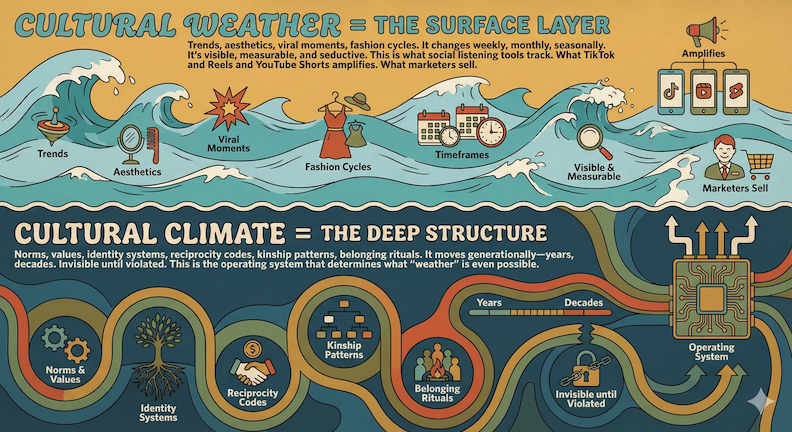
Cultural time flows. Based on a prompt to Nano Banana Pro
Deep culture works largely through binary oppositions (as per Claude Lévis-Strauss) which is how we pair concepts to make meaning and brands need to make meaning. Such as authentic/fake, traditional/modern, insider/outsider.
Cracker Barrel is a prime example of what happens when you mess with the climate side. It was traditional/insider and authentic. They blew up all three at once. Flat, tech company style logo, minimalist modern interior redesigns and being overly commercial, dropping any sense of tradition. Now wonder they reverted back. Brands don’t own their climate-level meaning. Customers do.
Understanding Where to Play
You’ve probably got lots “weather monitoring” tools; social listening, trend reports, AI-powered sentiment analysis and so on. These are perfect for tracking the surface signals. But they’re blind to climate. Not even tools like ChatGPT, Copilot or Claude help much with climate since they’re rear-view mirrors and can’t do deep dives.
You can use these tools to tell you what customers are doing, but can’t tell what that behaviour means. They can’t identify identity structures, rituals. This is where cultural intelligence comes into play.
To figure out what cultural clock you’re operating on, ask the following questions;
Weather questions:
What aesthetic signals are shifting in our category?
What trends can we authentically participate in?
What surface-level refreshes would feel current without feeling jarring?
Climate questions:
What meaning system does our brand participate in?
What identity structures have customers built around us?
What are the sacred boundaries we cannot cross without triggering a sense of betrayal?
When brands know where they’re playing and how, it makes strategy a little easier and figuring out engaging in channels more effective. Brands can and should play in both streams and be deliberate in doing so.
