
Culture is one of the more complex and nuanced words in the English language For most people, they think of culture as music, art, literature, fashion, music. But that’s just one aspect of culture. It also includes political and economic systems, how we organize our societies. And more deeply, the myths and stories we tell, rituals, customs, norms, behaviours and how we make meaning. So it’s a packed word and isn’t really defined.
For marketers, culture, understanding it and how it helps create ever more value to a brand is more important than ever. In fact, I argue, based on my 15 years as a CMO and 25 in marketing overall and my background as a practicing cultural anthropologist, that driving revenue starts with culture.
Over the last fifteen years or so, most marketing campaigns and strategies have started the top of the marketing funnel with buyer psychology. Largely using demographics and psychographics along with personas. It’s delivered results, but it could deliver better results, more revenues, better brand value over time, if culture is the top layer of the funnel, before buyer psychology. Because when it is, buyer psychology becomes even more effective and data becomes more viable too.
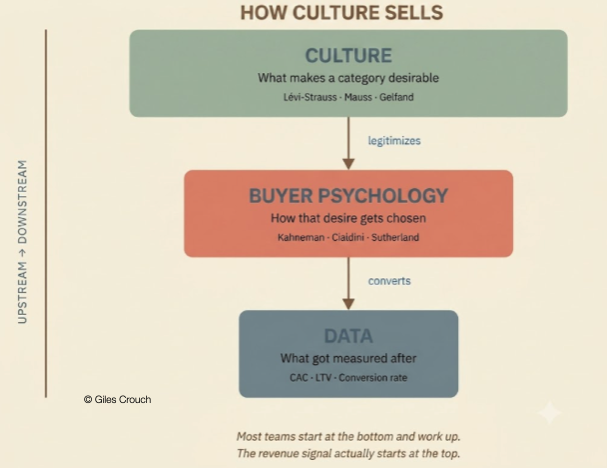
Image created using Gemini.
Buyer psychology optimizes conversion inside of a category people already believe in. But they believe in a category because of culture. Think of culture as humanity’s operating system (humanOS?). For marketers, think of how Scott Galloway put it “brand=margin”. What he means is that culture is the mechanism that creates margin before buying psychology comes into play.
If you’re thinking, well, we use demographics and psychographics too and have these great personas, well, yes, but that’s just individuals. Demographics and psychographics describe who's in a group; culture explains what the group actually believes and rituals it enacts. Almost every purchase we make starts from the cultural we were born into, live in and use to make meaning of our world and lives. Another aspect of cultural elements at work is if we live in what psychologist Michele Gelfand calls tight and loose cultures.
Other cultural elements that come into play, always, are people’s rituals, norms, behaviours, customs and social groups. People develop their own rituals and personal behaviours, but all are informed by the culture in which they live. Social groups all have their own rituals, myths, social norms and such. Especially subcultures.
When a marketing team understands these elements (major brands do, like Nike, McDonalds, Coca-Cola etc.) they create richer understanding of their audience. It’s why they often influence culture and sometimes, even shape it. That takes a lot of time and massive marketing budgets.
But SMEs too, can now harness cultural insights better than ever. They can use AI tools like Claude or ChatGPT for baseline research and testing assumptions. Just remember that AI tools are archives of what’s already known, they can’t predict cultural shifts or trends. Humans still need to do that part. Trends are a symptom of cultural codes. What marketers need to capture around a trend is the cultural shift causing it. This better informs strategy and creative, campaign designs.
"Culture doesn't convert. It sets the price everything downstream gets to charge."
Buyer psychology and the data you get out of campaigns can explain why someone might click. But before that comes the “why” the click might even happen. When you know the culture within which your brand sits, it enables you to create even better campaigns and creative (also avoiding any cultural landmines) so the buyer psychology you put into play becomes richer and much more informed. And drives higher revenues.
Okay, so it may sound complicated, but it’s not. In the next few weeks I’m launching the program “Why Culture Sells” for marketers to learn how to leverage cultural insights for their marketing. With practical tools and frameworks that can be easily applied to drive results, make your buyer psychology efforts even richer and help improve CAC and LTV. Stay tuned.
Oh and if you want to up your buyer psychology game today, I highly recommend “Why We Buy” from Katelyn Bourgoin. Super valuable.
